History’s Greatest Ballstrikers
Ball striking is defined by face-center contact, trajectory and spin control, and repeatable mechanics under pressure. Elite ball strikers consistently deliver compression, start the ball on their intended line, and control distance regardless of course conditions.
The standard for exceptional ball striking spans historical legends, modern tour leaders, and elite swing models.
The All-Time Legends
Ben Hogan: The benchmark for precision. Known for his legendary practice regimen, Hogan eliminated the left side of the golf course with a tight, penetrating fade and possessed complete control over clubface orientation at impact.
Moe Norman: Referred to as "Pipeline Moe" for his single-plane swing and unmatched accuracy. Tiger Woods and Lee Trevino both famously noted that Norman was one of the few players in history who truly "owned" his swing and wore out the exact sweet spot on his clubs.
Lee Trevino: A master of trajectory control and low-spinning fades. Despite an unconventional, open setup and flat swing path, Trevino was mechanically precise, controlling spin and ball flight in extreme wind conditions.
Tiger Woods (Peak Era): Particularly from 1999 to 2000, Woods displayed arguably the greatest combination of power, iron control, and distance management in golf history, hitting 75% of greens in regulation during his 2000 season.
Modern & Contemporary Masters
Scottie Scheffler: The modern gold standard for Strokes Gained: Approach and Tee-to-Green performance. Despite non-traditional footwork, his body rotation and ground force delivery yield elite face-to-path consistency and distance control.
Collin Morikawa: Built his major-winning career on elite iron play. His slight lead-wrist bowing at the top creates exceptional lag and compression, allowing him to attack tight pin locations with extreme precision.
Rory McIlroy: Considered by many to be the premier driver of the golf ball in modern history. His kinematic sequence and hip speed generate high launch and low spin with unmatched efficiency off the tee.
Henrik Stenson & Sergio García: Stenson’s legendary 3-wood precision and García’s signature shallowing motion and wrist lag made both players dominant ball strikers throughout their peak careers.
Purest Swing Aesthetics
Player. Defining Ball-Striking Characteristic
Adam Scott
Textbook swing plane, immaculate tempo, and flawless posture through impact.
Louis Oosthuizen
Legendary rhythmic sequencing and effortless power transfer.
Nelly Korda
Unmatched rotational efficiency, synchronization, and tempo in women's golf.
Sources
Elite iron compression and precise divot control are not created by "hitting down" on the ball, but rather by compressing the ball against the turf through an optimized impact position. Achieving this requires specific kinematic sequencing, shaft lean, forward dynamic loft reduction, and proper low-point control.
Here is the mechanical and biomechanical breakdown of how elite players generate heavy, penetrating iron shots with consistent turf interaction.
1. Lower-Body Kinematics & Ground Reaction Forces
Shift Before Turn: The transition begins with a lateral micro-shift of the pressure toward the lead foot before the backswing reaches completion. Peak lead-foot lateral force occurs at arm-parallel in the downswing.
Vertical Force & Lead Hip Extension: As the club nears impact, the lead hip snaps upward and backward. This rapid extension creates vertical ground reaction force, enabling the torso to rotate forcefully while keeping the spine stabilized.
Weight Distribution at Impact: Elite strikers have approximately 75–85% of their body weight/pressure on the lead side at impact, ensuring the low point of the swing arc is established in front of the ball.
2. Dynamic Shaft Lean & Wrist Mechanics
Backswing (Hinged) --> Downswing Lag --> Impact (Bow/Flex) --> Release
Lead Wrist Flexion (Bowing): Elite iron players transition from a flat or slightly extended lead wrist at the top into flexion (bowing) through the downswing. This Delofts the clubhead dynamically—turning a 7-iron into a 5-iron dynamic loft at impact.
Trail Wrist Extension (Cupping): The trail wrist stays extended ("hinged back") into impact, supporting the shaft lean and keeping the clubface square to the path.
Handle Ahead of the Blade: At impact, the hands are positioned forward of the ball. This forces the clubface to contact the ball first at a negative angle of attack before contacting the turf.
3. Angle of Attack & Low-Point Control
Variable. Tour Average (7-Iron). Amateurs (Typical). Effect on Compression
Angle of Attack
-3.5° to -4.5°
+1.0° to -1.0°
Ensures ball-then-turf contact without flipping.
Low Point Location
3 to 4 inches past ball
Directly at or behind ball
Controls divot position and hit quality.
Dynamic Loft
~19° to 21° (on a 34° iron)
~26° to 30°
Translates clubhead speed into ball speed.
Spin Loft
~20° to 24°
>30°
Optimizes energy transfer (smash factor)
4. Rotational Cleared Position & Kinematic Chain
Pelvis & Thorax Separation: At impact, the hips are open roughly 35° to 45° toward the target, while the shoulders are open roughly 10° to 20°. This rotational separation creates space for the arms to drop inside without steepening the shaft excessively.
Side Bend (Lateral Flexion): The trail shoulder drops lower than the lead shoulder through impact due to right side bend (for a right-handed golfer). This allows the chest to cover the ball while maintaining the spine angle established at address.
Summary of the Impact Geometry
To achieve true compression, the low point of your swing circle must occur after the ball. By maintaining lead wrist flexion, shifting pressure early to the lead side, and opening the hips through impact, the club contacts the ball while still traveling downward on its arc, creating a shallow, clean divot that starts directly in front of where the ball rested.
Great ball strikers separate themselves from tour-average players not through raw clubhead speed, but through face-to-path control, low-point predictability, and dynamic energy transfer. While tour pros are all elite, the historical outliers manipulate the physics of impact with near-zero variability.
1. Micro-Variability in Dynamic Loft and Face Angle
Average tour players miss their intended dynamic loft or face-to-path angle by a couple of degrees under pressure. All-time ball strikers keep this window virtually closed:
Centerness of Contact: Elite strikers consistently hit within a 2-millimeter radius of the clubface's sweet spot. Off-center hits degrade gear effect and launch parameters; elite players eliminate heel/toe gear effect entirely on iron play.
Minimal Face Rate of Closure: Players like Ben Hogan, Moe Norman, and Collin Morikawa square the clubface early in the downswing and hold it square relative to their path through impact. Because the face isn't violently rotating open-to-closed at the bottom, their timing window for a straight shot is significantly wider.
2. Extreme Low-Point Precision Across Turf Conditions
A Tour-average player’s low point might fluctuate by half an inch to an inch forward or backward depending on lie, slope, or pressure. Great ball strikers control their low point to millimeter-level accuracy:
Turf Interaction After Impact: They reliably enter the turf after ball contact regardless of heavy rough, tight fairways, or wet ground.
Divot Geometry: Their divots are shallow, uniform in depth, and start consistently 1 to 2 inches ahead of where the golf ball sat. This prevents energy loss from digging too deep into the ground.
3. Superior Kinematic Energy Sequence
Pelvis Acceleration --> Thorax Acceleration --> Arms --> Hands/Clubhead
While many players generate power by pulling hard with the upper body or flipping the wrists, elite ball strikers rely on an unbroken kinetic chain:
Proximal-to-Distal Deceleration: The lower body (pelvis) fires first and then drastically decelerates to transfer energy into the torso. The torso accelerates and decelerates to transfer energy into the arms, whipping the clubhead through the ball without manual hand manipulation.
Structural Stability: At impact, their lead leg acts as a rigid brace. This abrupt deceleration of the lower body converts horizontal movement into violent rotational and vertical force.
Key Differentiators at Impact. Parameter. Tour Average. All-Time Ball Strikers
Sweet Spot Variance
~4mm to 6mm dispersion
< 2mm dispersion
Low-Point Variance
± 0.75 inches
± 0.25 inches
Smash Factor (7-Iron)
~1.33 to 1.35
1.38+ (Near theoretical max)
Face Rotation Rate at Impact
~1,200°/sec
< 800°/sec (More stable face)
Ultimately, the elite group stands apart because their mechanics minimize the effect of human error. Even on an "off" day, their swing geometry guarantees solid compression and controllable start lines.
Reducing the clubface rate of closure through impact expands your hit zone, allowing the clubface to stay square to the target line longer. A high rate of closure usually stems from trying to square an open face late in the downswing using independent hand and forearm rotation ("flipping").
To stabilize the face rate through impact, focus on four key mechanical adjustments:
1. Square the Face Early in the Downswing
The Cause: If the clubface is wide open at the P6 position (shaft parallel to ground in downswing), your brain subconsciously panics and stall-releases the hands to flip the toe closed.
The Fix: Match your clubface angle to your spine angle early in the downswing. As you transition, flex (bow) your lead wrist to close the face to your swing path before impact. When the face is already square early, you don't need a rapid wrist flick to hit the ball straight.
2. Drive Squaring via Body Rotation (Passive Hands)
The Cause: Stopping or slowing down pelvic and chest rotation forces the hands and arms to rapidly flip past the body.
The Fix: Use chest and hip rotation to pull the arms through impact. Keep the lead hip extending and opening through the ball; active core rotation allows the arms and clubface to passively track along the arc, holding the face angle stable relative to your path.
3. Maintain Dynamic Shaft Lean and Lead Wrist Flexion
The Cause: Early extension or throwing wrist lag ("casting") causes the club shaft to back up at impact, causing high face rotation.
The Fix: Ensure the hands remain ahead of the clubhead at impact. Keeping lead wrist flexion (palms down feeling) through impact holds the face perpendicular to the target path far longer.
4. Shallow the Swing Path
The Cause: Over-the-top, steep attack angles force late, violent wrist rotation to prevent deep digging or high push-slice trajectory.
The Fix: Shallow the shaft in transition so the club approaches from slightly inside the target line. A shallow plane reduces the need for steep compensated hand action.
High vs. Low Rate of Closure Mechanics. Swing Component. High Rate of Closure (Unstable Start Line). Low Rate of Closure (Elite Consistency)
P6 Clubface Position
Open (Toe pointing straight up or back)
Square (Face matching spine angle)
Impact Motor
Hand flip & forearm roll
Body rotation & pivot speed
Lead Wrist at Impact
Extended (cupped) / throwing lag
Flexed (bowed) / holding shaft lean
Pivot Through Impact
Stalled hips, early extension
Open hips (40°+), chest covering ball
Easy Drills
1) Lead Wrist Motorcycle Drill
Train early face squaring
At top of backswing, initiate downswing by feeling your lead wrist curl down like revving a motorcycle handle. Stop at shaft-parallel (P6) and verify the face angle matches your spine angle before completing half-swings.
2) Alignment Stick Shaft Extension Drill
Eliminate late hand flip
Grip a alignment stick alongside your iron shaft so 2 feet of the stick extends past your lead hip. Take slow 3/4 swings—if your wrists flip or stall rotation through impact, the stick will hit your lead side.
Beyond the Rack: Performance Club Fitting Protocols
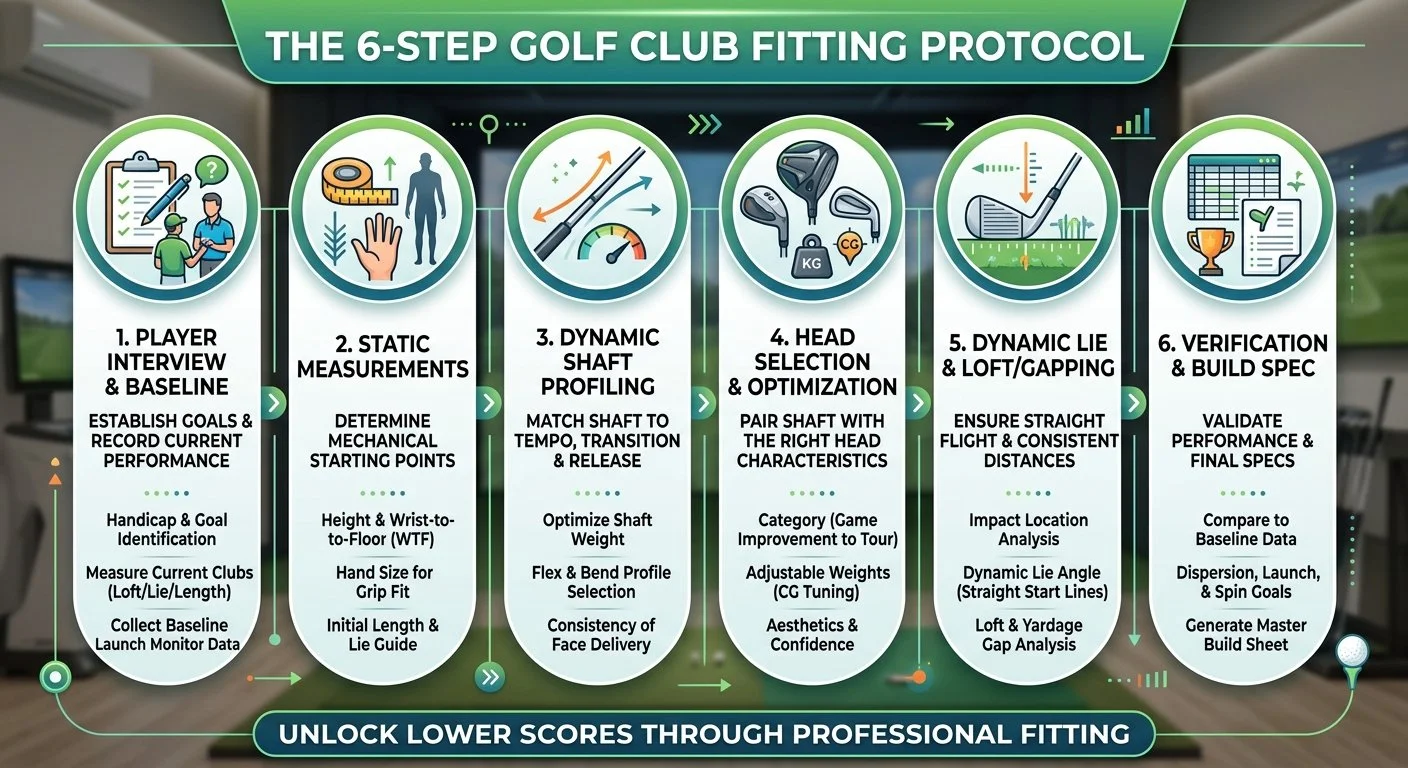
Step 1: The Interview & Baseline Assessment
A true fitting never begins with a club in your hand. It begins with a conversation.
Before hitting a single ball, a master fitter conducts a comprehensive interview to understand your game beyond the launch monitor data.
Game Diagnostics: What is your typical miss? What are your scored rounds looking like? Where do you leak strokes during a round?
Physical Considerations: Do you have past injuries, flexibility limitations, or swing adjustments you’re currently working on with a teaching professional?
Goal Setting: Are you looking to stop a slice, get higher launch on long iron shots, or achieve predictable carry distances through your wedges?
Once your goals are established, the fitter measures your current equipment—recording lofts, lie angles, shaft weights, flexes, lengths, and swing weights. You will then hit 8 to 10 shots with your existing setup to establish a baseline. This provides hard data on your current carry distance, launch angle, spin rate, peak height, land angle, and dispersion footprint.
Step 2: Static Profiling (Building the Starting Point)
Before dialing in dynamic swing movement, the fitter takes static body measurements to establish a mechanical baseline:
Wrist-to-Floor (WTF) Distance: Combined with your height, this helps determine standard starting lengths and lie angle baselines.
Hand & Finger Size: Dictates proper grip diameter. A grip that is too thick can hinder wrist release (causing a push or slice), while a grip that is too thin can encourage overly active hands (leading to a hook).
Static specs don't dictate the final build, but they eliminate guesswork and give the fitter a logical starting block.
Step 3: Shaft Profiling (The Engine of the Club)
Many golfers assume the clubhead is the most important component, but the shaft acts as the timing mechanism of the golf swing. If the shaft doesn't match your tempo, transition, and release point, consistent center-face contact becomes nearly impossible.
During this phase, fitters isolate shaft characteristics while keeping the clubhead constant:
Shaft Weight First: Weight influences your rhythm and overall swing speed more than flex. A shaft that is too light leads to erratic tempo and inconsistent impact locations; a shaft that is too heavy causes fatigue and a drop in speed.
Flex & Bend Profile: Matching stiffness and kick-point (low, mid, high) ensures the shaft flexes and releases at the exact moment your clubhead meets the ball.
The key metrics to monitor here are smash factor (ball speed divided by clubhead speed) and face angle consistency. When you hit the shaft profile that matches your swing, your strike pattern tightens dramatically.
Step 4: Head Selection & Optimization
Once shaft delivery stabilizes, the fitter turns to head geometry, weighting, and center of gravity (CG):
Category Selection: Matching your skill level and striking profile to Super Game Improvement, Game Improvement, Players Distance, or Tour Performance heads.
Weight Distribution: Adjusting perimeter weighting or internal CG to optimize launch angles and counteract directional biases (like helping close a face that stays open at impact).
Aesthetics & Confidence: You must like what you see at address. Confidence at address directly impacts tension levels in your grip and shoulders.
Step 5: Dynamic Impact & Turf Interaction
Static charts only tell part of the story. How the club interacts with the turf and the ball at impact dictates real-world performance.
Using face tape, impact spray, and high-speed cameras, the fitter analyzes dynamic delivery:
Dynamic Lie Angle: If your iron’s lie angle is too upright at impact, the heel touches first, pointing the face left of target (for a right-handed player). If it's too flat, the toe digs, pushing shots right. Adjusting lie angle ensures straight start lines.
Loft & Gapping Optimization: For irons and wedges, lofts are adjusted to ensure predictable 10-to-12-yard carry gaps between every club in your bag. Eliminating distance "dead zones" is one of the fastest ways for amateurs to lower scores.
Land Angle: For irons, stopping power matters as much as carry distance. A proper fit ensures a steep land angle (typically 45° or higher) so your approach shots hold greens rather than rolling off the back.
Step 6: Spec Verification & Target Benchmarks
Before wrapping up, the fitter compares your custom-spec numbers against your original baseline data to quantify improvement across key performance metrics:
Metric. Baseline (Your Current Club). Custom Spec Target. On-Course Benefit.
Dispersion Pattern. Wide / Erratic. Compact Ellipse. Fewer missed greens & penalty areas
Driver Spin Rate High (>3,000 RPM). Optimal (2,000–2,400 RPM). Increased rollout and maximum carry
Iron Landing Angle Shallow (<40°). Steep (45°–50°). Shots stop quickly on approach. KEY METRICS for 7iron: Ideal Apex Range - Clubhead speed : Apex = 1:1; Ideal Carry - Clubhead speed to carry = 1:2
Impact Location Heel / Toe Scattering. Center-Face Cluster. Consistent distance control
The Result: Equipment Built for Your Swing
At the end of a professional fitting, you leave with a comprehensive build sheet detailing every exact specification: head model, loft and lie adjustments, shaft model, flex, weight, tipping, length, swing weight, and grip wraps.
Playing equipment built specifically for your body dynamics and swing delivery removes the guesswork from your game. When you know your clubs are optimized to perform, you can stop fighting your equipment and start focusing on course management, target execution, and lower scores.
Marksmanship & Golf Flow State
Unlocking the Flow State: What Target Shooting Teaches Us About the Golf Swing
Whether you are pulling a trigger or swinging a golf club, peak performance relies on the exact same psychological condition: transient hypofrontality. This is the classic "flow state"—a moment where your prefrontal cortex quiets down, conscious internal dialogue vanishes, and execution occurs strictly through subconscious motor programming.
Instead of forcing results, top performers shift from "trying hard" to becoming passive observers of a system operating on deep muscle memory, autonomic regulation, and complete sensory immersion.
The Secret Engine: The Quiet Eye Phenomenon
In high-precision target sports, flow is triggered by the Quiet Eye (QE) phenomenon—a motionless, hyper-specific visual fixation on a single target node for 1.5 to 3.0 seconds immediately before motion initiation. Quiet Eye suppresses visual noise, lowers heart rate, and stabilizes the brain's motor planning centers.
Game Phase. Target QE Fixation Node. Primary Mechanical Benefit
Putting Single dimple or letter on ball. Prevents "peeking" and face manipulation; smooths stroke tempo.
Driver / Full Swing Back-inside quadrant (4 o'clock position). Encourages inside-out path, upward angle of attack, and solid compression.
Iron Shots 1/2" to 1" directly in front of the ball. Lowers kinetic low-point ahead of impact for crisp ball-then-turf contact.
Partial Wedges 1/4" in front + visual focus on landing spot. Calibrates backswing length and eliminates early head rise or deceleration.
The 5-Step Flow Pre-Shot Routine
To transition from conscious mechanics to subconscious execution under pressure, follow this universal 5-step flow protocol:
Down-Regulate Autonomic Arousal: Perform a physiological sigh (two quick nasal inhales followed by one long mouth exhale) to drop your heart rate and release upper-body tension.
Calibrate Spatial Feel: Look directly at your target node (landing spot or cup) while making practice swings to map distance directly to muscle tension.
Lock the Micro-Node: Set up over the ball and lock your gaze on a hyper-specific micro-spot (not the whole ball) for 1.5 to 2.0 seconds.
Subconscious Execution: Initiate motion on a smooth exhale, allowing the motor sequence to fire automatically without conscious steering.
The Post-Impact Dwell: Hold your eye gaze on the empty turf spot for 0.3 to 0.5 seconds post-impact before tracking the result.
By anchoring your vision and letting your subconscious take over, you eliminate outcome anxiety, lock into the present moment, and execute effortlessly when the pressure is on.
For more, download the flow state manual below:
Ground Reaction Forces
Ground reaction forces in the golf swing act across three distinct directional axes: Horizontal (Lateral), Rotational (Torque), and Vertical.
In high-speed swings, these forces execute in a precise temporal sequence—lateral first, rotational second, vertical last—each contributing uniquely to kinetic chain velocity.
The Three Ground Reaction Force Vectors
1. Horizontal (Lateral) Force — The Initiator
Direction: Side-to-side force along the target line (X-axis).
Peak Timing: Very early in the transition (before the club completes the backswing).
Role in Speed: Creates the initial mass shift toward the target. By pushing off the inside of the trail foot, it establishes the lead-side pivot dynamic and creates spatial room for the arms to drop into the slot.
Speed Contribution: Low direct clubhead speed generation (~10–15%), but acts as the essential positioning phase for the secondary forces.
2. Rotational Force (Horizontal Torque) — The Engine
Direction: Equal and opposite shear forces between the feet (Y-axis)—pushing forward toward the ball line with the lead foot while pulling backward with the trail foot.
Peak Timing: Midway through the downswing (when the lead arm is parallel to the ground).
Role in Speed: Drives pelvic rotation. This twisting force against the ground converts linear momentum into angular velocity, uncoiling the hips and torso relative to the lower body.
Speed Contribution: Moderate-to-high direct contribution (~25–35%), primary driver of body rotation rate.
3. Vertical Force — The Multiplier
Direction: Upward push straight out of the ground (Z-axis).
Peak Timing: Late downswing, just before impact (shaft parallel to the ground).
Role in Speed: Converts downward body pressure into vertical elevation (lead knee extension). Because the lead hip is offset from the center of rotation, pulling the lead hip upward accelerates the lead shoulder up and back, rapidly snapping the handle upward and whipping the clubhead through impact.
Speed Contribution: Highest magnitude driver (~50%+ of overall ground-generated speed in long hitters).
Comparison & Kinematic Sequence
Force Vector. Primary Mechanical Goal. Peak Force Timing. Peak Magnitude (% Body Weight)
Horizontal (Lateral) Weight transition to lead foot. Late backswing / early transition. ~25–30% BW
Rotational (Torque) Torso uncoiling / pelvic rotation. Lead arm parallel downswing. ~100–120% BW
Vertical Lead side extension ("posting"). Shaft parallel downswing. 150–200%+ BW