Beyond the Rack: Performance Club Fitting Protocols
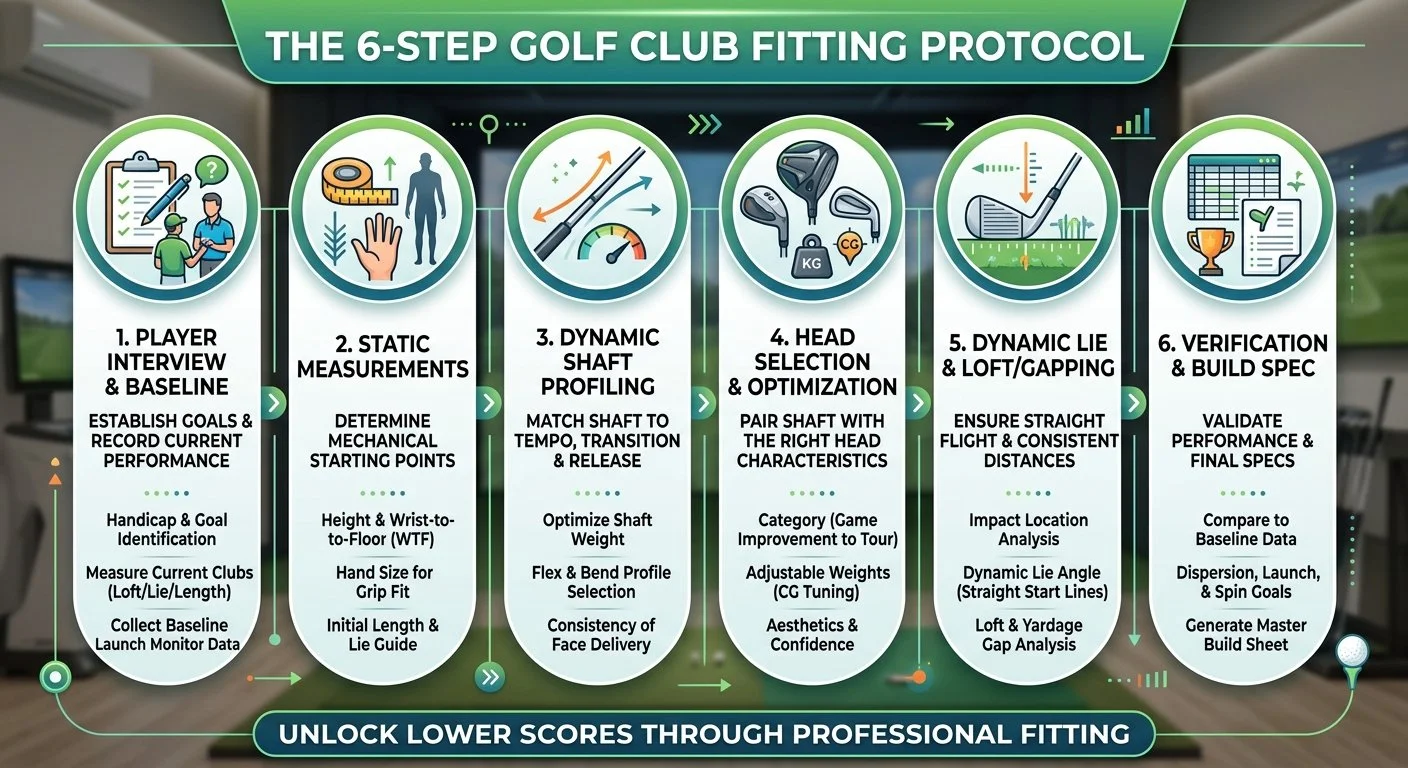
Step 1: The Interview & Baseline Assessment
A true fitting never begins with a club in your hand. It begins with a conversation.
Before hitting a single ball, a master fitter conducts a comprehensive interview to understand your game beyond the launch monitor data.
Game Diagnostics: What is your typical miss? What are your scored rounds looking like? Where do you leak strokes during a round?
Physical Considerations: Do you have past injuries, flexibility limitations, or swing adjustments you’re currently working on with a teaching professional?
Goal Setting: Are you looking to stop a slice, get higher launch on long iron shots, or achieve predictable carry distances through your wedges?
Once your goals are established, the fitter measures your current equipment—recording lofts, lie angles, shaft weights, flexes, lengths, and swing weights. You will then hit 8 to 10 shots with your existing setup to establish a baseline. This provides hard data on your current carry distance, launch angle, spin rate, peak height, land angle, and dispersion footprint.
Step 2: Static Profiling (Building the Starting Point)
Before dialing in dynamic swing movement, the fitter takes static body measurements to establish a mechanical baseline:
Wrist-to-Floor (WTF) Distance: Combined with your height, this helps determine standard starting lengths and lie angle baselines.
Hand & Finger Size: Dictates proper grip diameter. A grip that is too thick can hinder wrist release (causing a push or slice), while a grip that is too thin can encourage overly active hands (leading to a hook).
Static specs don't dictate the final build, but they eliminate guesswork and give the fitter a logical starting block.
Step 3: Shaft Profiling (The Engine of the Club)
Many golfers assume the clubhead is the most important component, but the shaft acts as the timing mechanism of the golf swing. If the shaft doesn't match your tempo, transition, and release point, consistent center-face contact becomes nearly impossible.
During this phase, fitters isolate shaft characteristics while keeping the clubhead constant:
Shaft Weight First: Weight influences your rhythm and overall swing speed more than flex. A shaft that is too light leads to erratic tempo and inconsistent impact locations; a shaft that is too heavy causes fatigue and a drop in speed.
Flex & Bend Profile: Matching stiffness and kick-point (low, mid, high) ensures the shaft flexes and releases at the exact moment your clubhead meets the ball.
The key metrics to monitor here are smash factor (ball speed divided by clubhead speed) and face angle consistency. When you hit the shaft profile that matches your swing, your strike pattern tightens dramatically.
Step 4: Head Selection & Optimization
Once shaft delivery stabilizes, the fitter turns to head geometry, weighting, and center of gravity (CG):
Category Selection: Matching your skill level and striking profile to Super Game Improvement, Game Improvement, Players Distance, or Tour Performance heads.
Weight Distribution: Adjusting perimeter weighting or internal CG to optimize launch angles and counteract directional biases (like helping close a face that stays open at impact).
Aesthetics & Confidence: You must like what you see at address. Confidence at address directly impacts tension levels in your grip and shoulders.
Step 5: Dynamic Impact & Turf Interaction
Static charts only tell part of the story. How the club interacts with the turf and the ball at impact dictates real-world performance.
Using face tape, impact spray, and high-speed cameras, the fitter analyzes dynamic delivery:
Dynamic Lie Angle: If your iron’s lie angle is too upright at impact, the heel touches first, pointing the face left of target (for a right-handed player). If it's too flat, the toe digs, pushing shots right. Adjusting lie angle ensures straight start lines.
Loft & Gapping Optimization: For irons and wedges, lofts are adjusted to ensure predictable 10-to-12-yard carry gaps between every club in your bag. Eliminating distance "dead zones" is one of the fastest ways for amateurs to lower scores.
Land Angle: For irons, stopping power matters as much as carry distance. A proper fit ensures a steep land angle (typically 45° or higher) so your approach shots hold greens rather than rolling off the back.
Step 6: Spec Verification & Target Benchmarks
Before wrapping up, the fitter compares your custom-spec numbers against your original baseline data to quantify improvement across key performance metrics:
Metric. Baseline (Your Current Club). Custom Spec Target. On-Course Benefit.
Dispersion Pattern. Wide / Erratic. Compact Ellipse. Fewer missed greens & penalty areas
Driver Spin Rate High (>3,000 RPM). Optimal (2,000–2,400 RPM). Increased rollout and maximum carry
Iron Landing Angle Shallow (<40°). Steep (45°–50°). Shots stop quickly on approach. KEY METRICS for 7iron: Ideal Apex Range - Clubhead speed : Apex = 1:1; Ideal Carry - Clubhead speed to carry = 1:2
Impact Location Heel / Toe Scattering. Center-Face Cluster. Consistent distance control
The Result: Equipment Built for Your Swing
At the end of a professional fitting, you leave with a comprehensive build sheet detailing every exact specification: head model, loft and lie adjustments, shaft model, flex, weight, tipping, length, swing weight, and grip wraps.
Playing equipment built specifically for your body dynamics and swing delivery removes the guesswork from your game. When you know your clubs are optimized to perform, you can stop fighting your equipment and start focusing on course management, target execution, and lower scores.